
How Southeast Asia actually buys in 2026
Social in Southeast Asia is no longer a media channel. It is now the search bar, the shopping mall, and the trust layer of commerce. This paper maps what matters to SEA consumers, what content actually converts, which storytelling is effective, and how buying decisions changed through 2026.
- 01 · Trust. Family, friends, and creators sit above brand and machine in the influence hierarchy.
- 02 · Content. Short video, live commerce, UGC, and micro-dramas convert. Polished studio ads do not.
- 03 · Story. Creator-led, lived-experience storytelling beats broadcast storytelling.
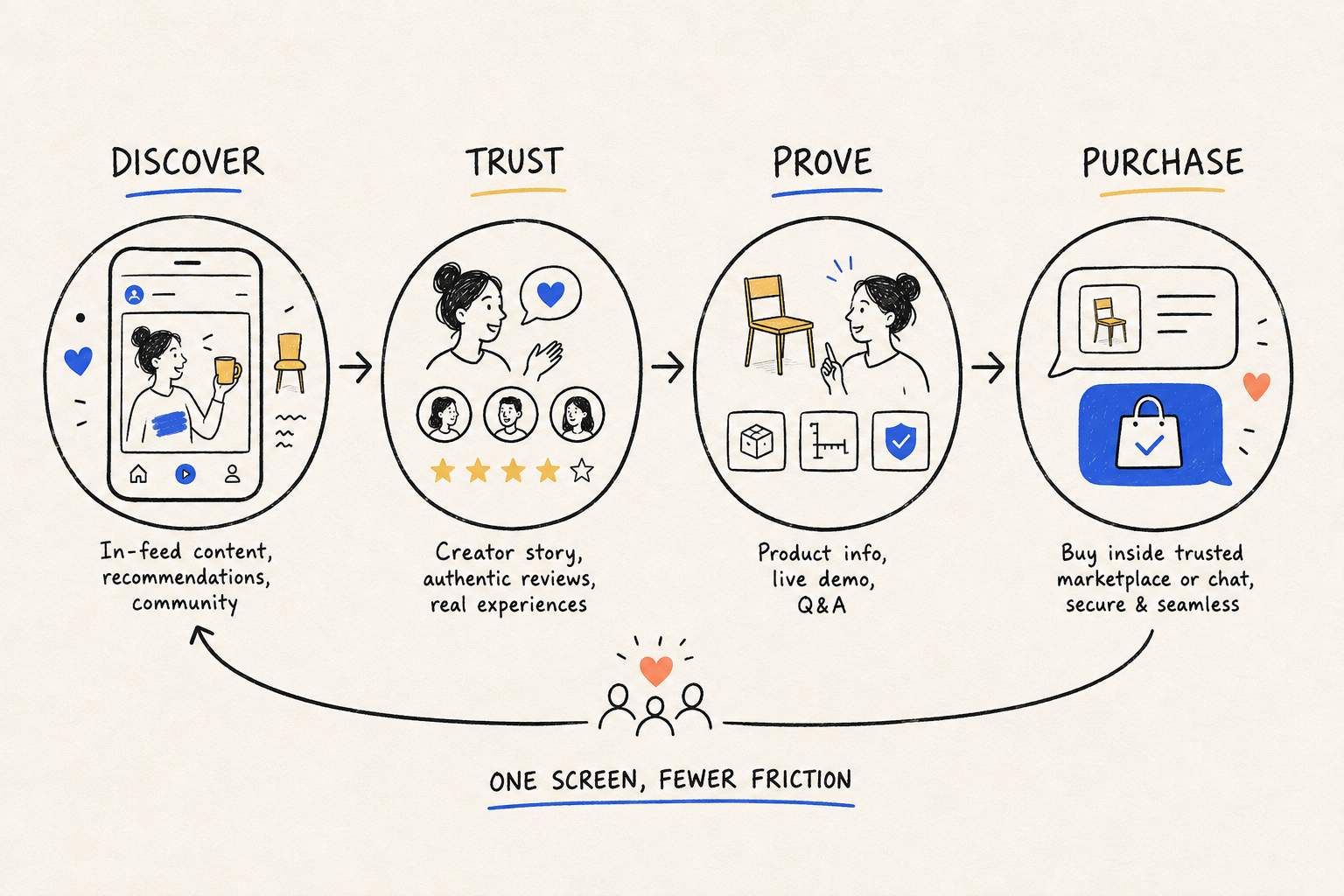
- 04 · Commerce. Buying is now a closed loop: discover, prove, and purchase in one screen.
The claim
The 2026 Southeast Asian buying journey is no longer a linear funnel. Discovery, trust, and purchase have collapsed into the social feed. Social commerce went from under 5% of regional e-commerce GMV to roughly 20 to 25% in under four years. It is a $47.6 billion market in 2025 heading toward roughly $186.5 billion by 2030, compounding at near 31% a year. That is about two and a half times faster than traditional e-commerce growth.
The practical implication for any brand or CMO: showing up where discovery happens now matters more than buying where conversion used to live. Most brands still optimize one surface. The market has moved to three.
Why people buy
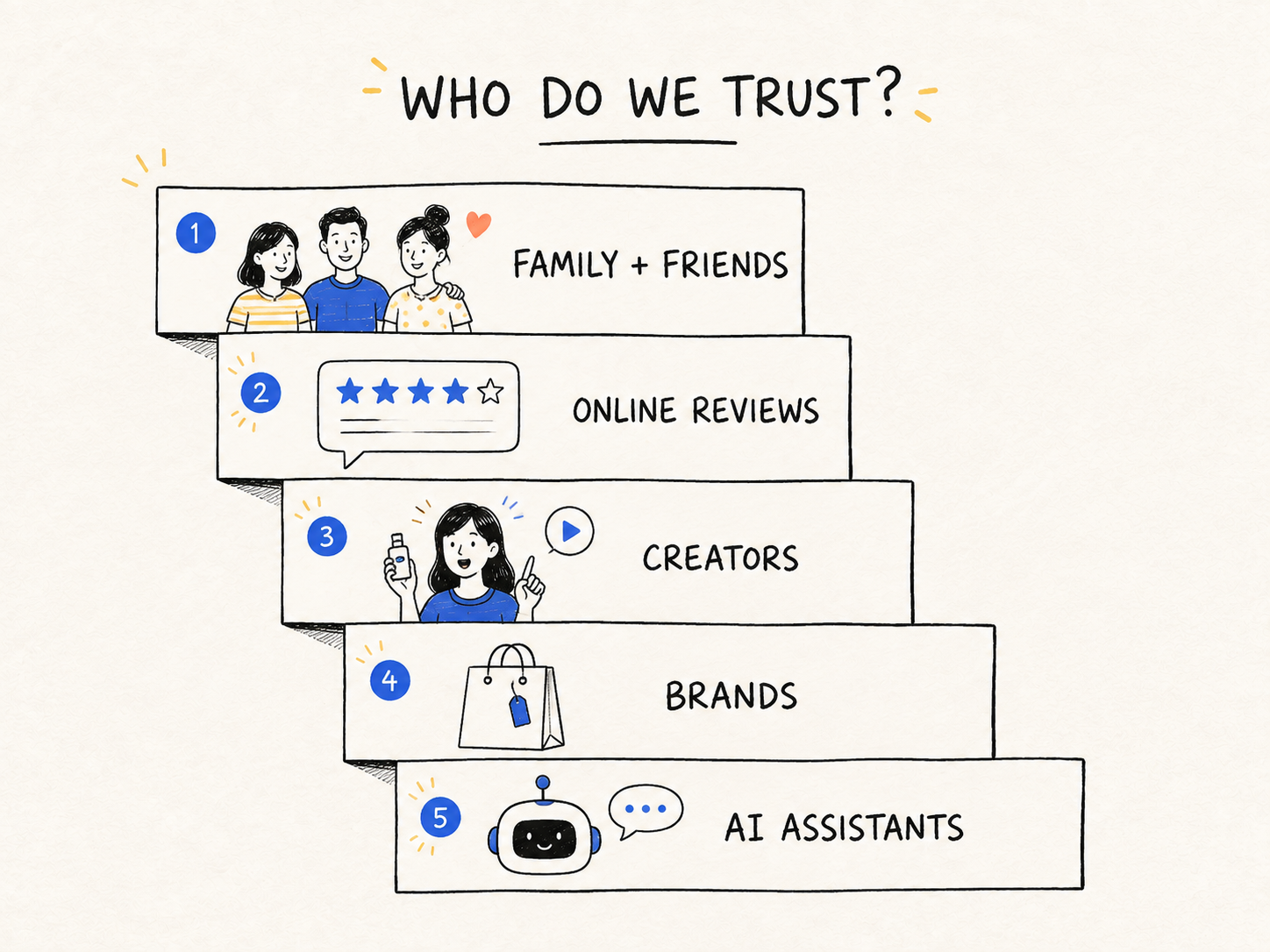
Asked who they believe when it is time to pay, SEA shoppers name family and friends first (rated 2.42 out of 4.0), online reviews second (2.36), and creators third (1.98). AI assistants rank last. Two thirds of consumers, around 67%, have bought a product specifically because a creator recommended it.
The conversion gap is the story. A micro-influencer recommendation converts around 82% of the time, against the 1 to 2% typical of traditional e-commerce. That is roughly a 40 times uplift. Communities in the region form around creators before they form around brands.
Micro beats mega
Micro-influencers with 2,000 to 10,000 followers generate roughly four times the engagement of million-follower accounts, and the pattern repeats across every major SEA market. Their communities feel like friends, not audiences. Product recommendations carry social credibility instead of tasting like advertising.
Platforms now rank relevance over follower count. A brand-new account can go viral on day one if the content triggers the right interest signal, while an established account can lose reach overnight when its content stops resonating.
The content that converts
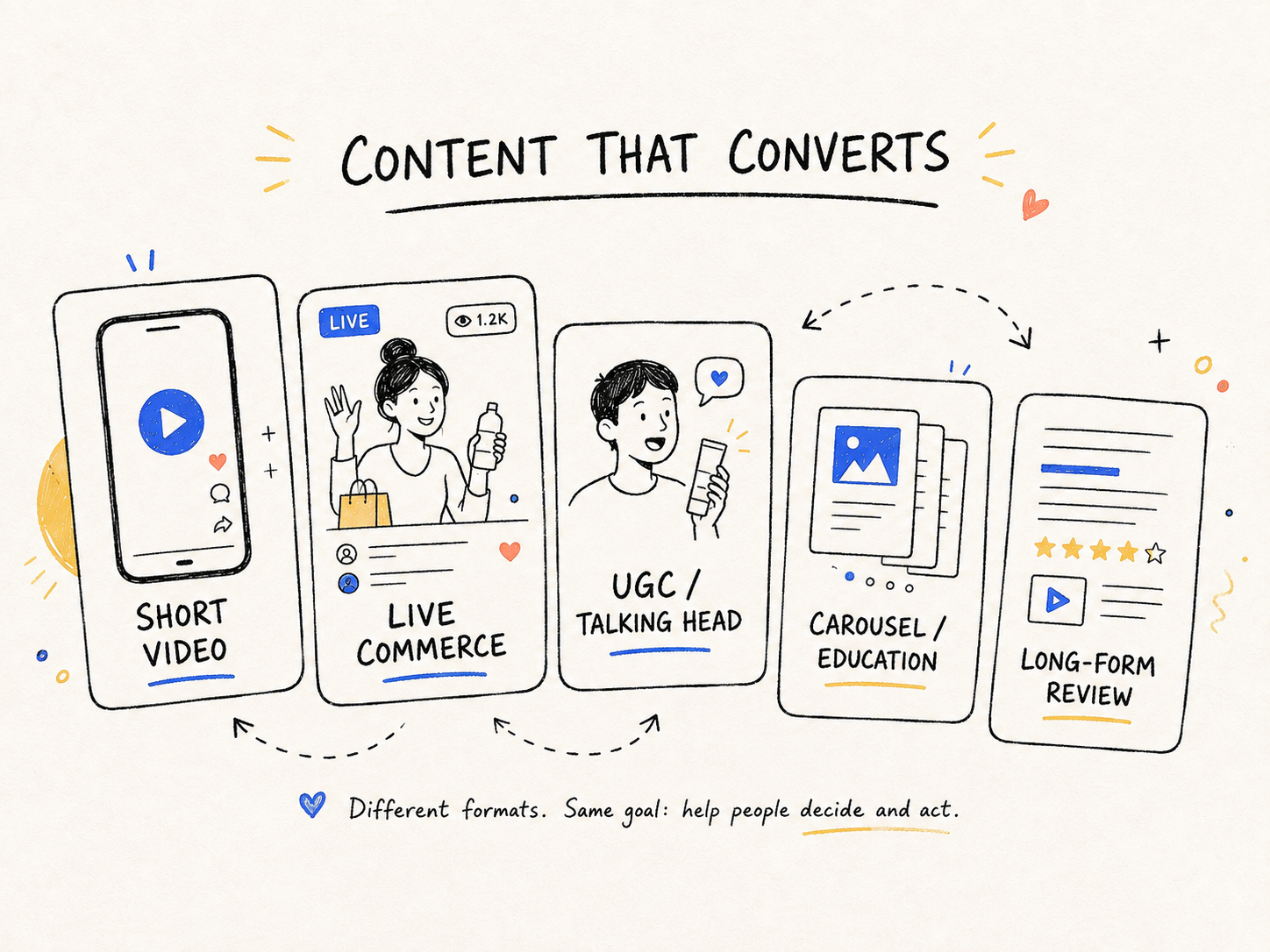
- Short-form video. Above 60% of all social consumption, and short-form views grew 36% year over year. It is the baseline craft for reaching SEA.
- Live commerce. Converts up to roughly 10 times traditional e-commerce. An average TikTok live holds attention for 23 minutes, and 35% of viewers repurchase within 30 days.
- UGC and creator talking-heads. Drives near 10 times the conversion of brand content. Imperfect but relatable execution wins.
- Carousels. Around 109% more engagement than Reels on Instagram, and strong for education and comparison.
- Micro-dramas. One to three minute emotional stories reach roughly eight times publisher benchmarks. They are large in Malaysia and Indonesia.
- Long-form YouTube reviews. Influence purchases weeks or months later; trust compounds across repetition.
- Chat commerce. Around 40% of Thai and 36% of Vietnamese shoppers buy through messaging apps. It is mainstream, not niche.
None of these reward polish. The biggest media waste in 2026 is still commissioning expensive, on-brand-sounding studio ads that the audience did not ask for.
The storytelling that works
Storytelling is confirmed as the strongest narrative form in the region. Around 79% of SEA social users engage more with creator content that feels like a story rather than an ad, and creator-led campaigns deliver roughly 3.5 times the engagement of traditional paid media (WARC Influencer Marketing Benchmark 2025).
The winning mode is not broadcast storytelling and it is not product placement. It is emotional placement: the brand enters a real lived moment and stays subtle in the story while remaining present in the outcome.
- Routine storytelling. A delivery service shown through a creator's midnight cravings and early-morning cooking. Natural, useful, believable.
- Behind-the-scenes. A creator experiencing the truth of the product, such as a durability lab visit, instead of hearing scripted claims.
- Short emotional micro-dramas. Serialized one to three minute stories rooted in local festival culture. NIVEA Malaysia lifted brand health and near-double-digit sales; Air Selangor drew 23.5 million views and an 18 point sentiment jump.
- Episodic quest narratives. A long-running serialized platform, not one-off ads. Shell Malaysia reversed two years of market share decline with its Quest storytelling system.
Storytelling works when the brand is subtle in the story and present in the outcome.
How the buying decision shifted in 2026
The funnel is not dead, but the journey changed permanently. Over 60% of product discovery now happens on TikTok, Instagram, and YouTube. One in three consumers starts product searches on a social platform instead of Google. Yet around 88% of purchases finish inside the marketplace they already trust.
Discovery and purchase have split. People use AI to decide faster (86% of Gen Z in Vietnam, Indonesia, the Philippines, and Thailand say AI search reduces decision fatigue), but they leave the assistant to buy from a human where it feels safe. The winning platform removes the gap entirely.
Around 85% of consumers switch apps during a fragmented journey. TikTok Shop compresses discovery, information, reviews, checkout, and payment into one screen with no context switching, no competitor price comparison, and no abandonment. By early 2026, that single-stream conversion path became the expected standard.
The market scale
SEA e-commerce is roughly $219 billion in 2026 and projected to near $410 billion by 2031. Indonesia and Thailand account for about 58% of regional sales. Influencer and affiliate marketing link to an estimated 32% of SEA e-commerce, equivalent to around $70 billion in 2026. The number of TikTok creators generating over $1 million in annual GMV tripled in a single year.
Indonesia is the centre of gravity
Indonesia has roughly 180 million social media users, up 26% in a single year, out of about 230 million internet users. It is TikTok's largest advertising audience on earth, with near-total adoption among women 18 and up. Indonesians average 38 hours and 26 minutes on TikTok per month, the highest of any platform, and about 3 hours and 17 minutes a day across social media.
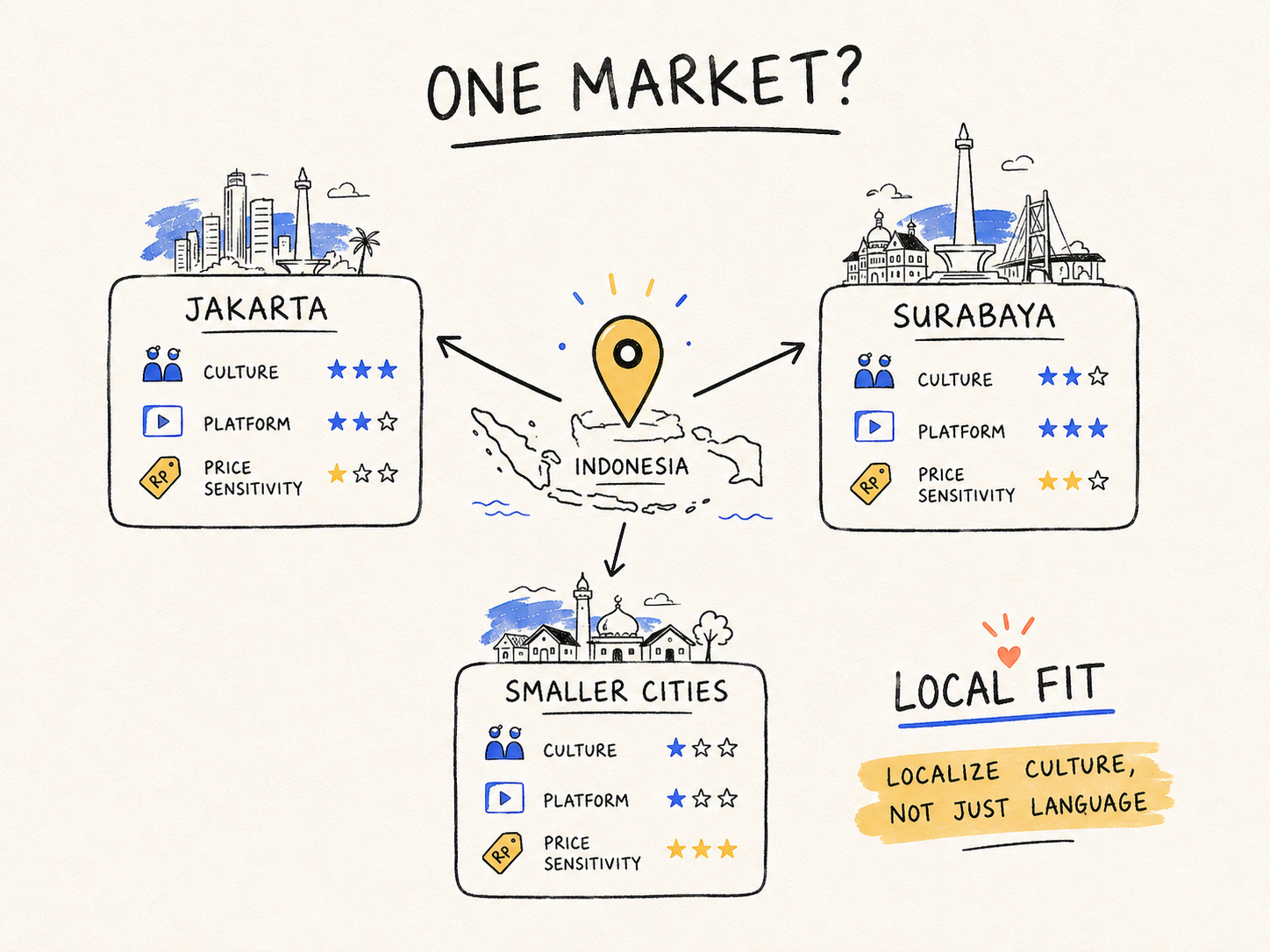
Around 82% of Indonesian users research products on social platforms, and WhatsApp is a daily utility. The caution: Indonesia is not one market. Jakarta, Surabaya, and smaller cities behave differently in values, platform use, and price sensitivity. One national playbook rarely fits.
What this means for brands
- Flip the funnel. Start where discovery happens. Put creative where the feed lives, not only where conversion used to sit.
- Go micro-first. Brief light, not tight. Clear message, defined boundaries, creative freedom. Let creators own the narrative.
- Build a closed loop. Single-stream purchase paths, shoppable video, and chat commerce remove the clicks that kill conversion.
- Use storytelling as emotional placement. Integrate the brand into real lived moments, and run it episodically so trust compounds.
- Localize culturally, not just linguistically. Native humor, pacing, and festival moments (Raya, Chinese New Year, Idul Fitri, Deepavali) beat translated global creative.
- Use AI for scale, humans for trust. AI reduces decision fatigue and speeds creative testing. People still want a human name attached before they pay.
- Measure like a creator. Read comment quality, saves, shares, watch time, and repurchase. Read the comments themselves.
Research notes
This paper aggregates public 2026 sources: DataReportal and We Are Social (Digital 2026), Meltwater, Hootsuite and Epilog Creative social trends, Indonesia Investments and Digital in Asia market notes, the Momentum Works and Bain, Google, Temasek e-Conomy SEA work, UGC and influencer benchmark reports, and regional campaign case studies (NIVEA, Air Selangor, Shell Malaysia, Julie's Biscuits). Figures are directional market data, not sole-authored results.
Relationships replace search. Recommendations replace algorithm exposure.
Reported figures are market and campaign contributions drawn from public 2026 sources and case studies, used for direction and planning rather than as sole-authored audit results.

Aditya Indra Bayu
·Fractional CMO · InfinitiLabsAditya builds and operates commercial growth engines from the inside. He connects positioning, funnels, paid media, and sales telemetry until the business finds durable revenue.