Why the Funnel is More Linear Than Ever in the Era of the Messy Middle
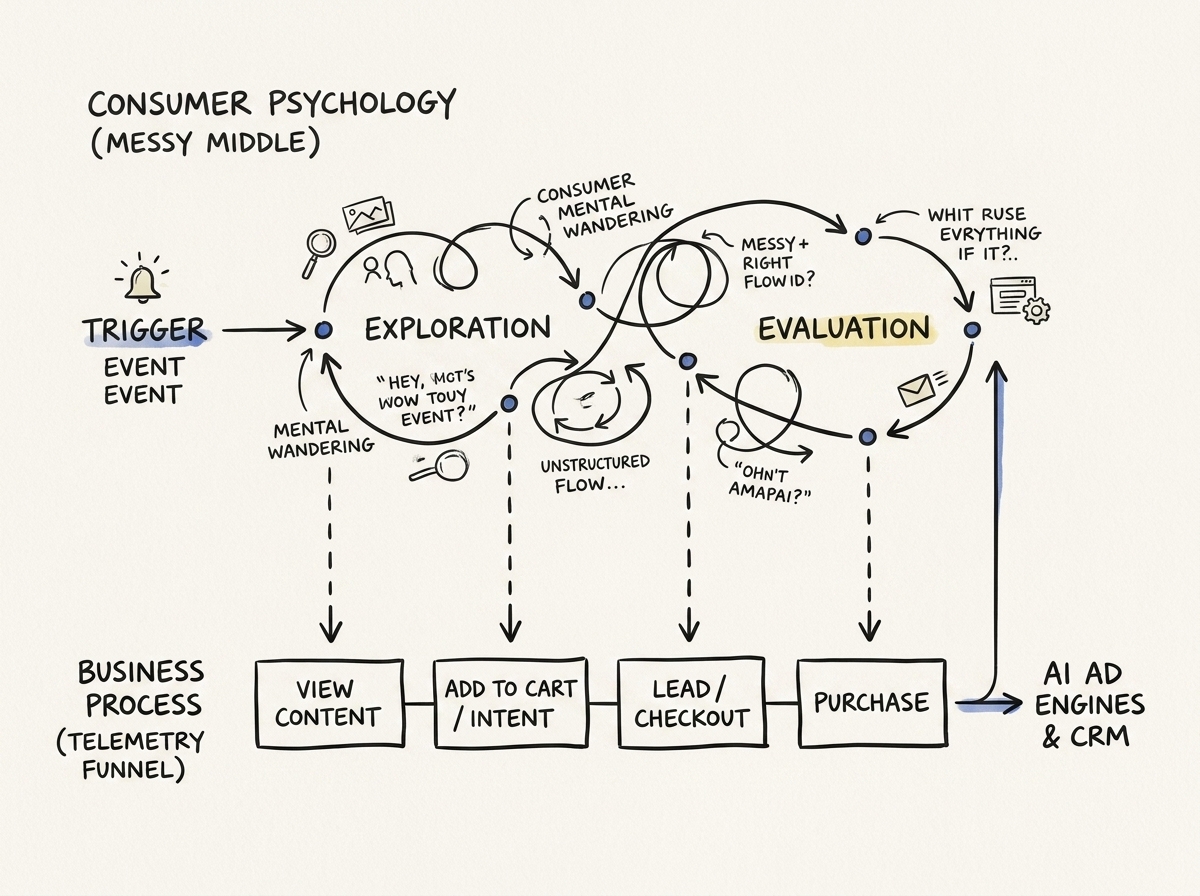
Customer journeys wander. Business processes cannot. While buyer psychology loops between exploration and evaluation in Google's Messy Middle, the commercial funnel remains a deterministic state machine: disciplined checkpoints that provide clean telemetry for AI ad engines to scale sustainably.
A persistent myth has taken hold across growth meetings and marketing channels: that because customer buying behaviour is non-linear, business funnels are dead.
Marketers constantly point to Google’s 2020 Messy Middle research as their proof. The argument usually sounds like this: buyers do not move along a straight line from awareness to purchase. They scroll, wander, compare, get distracted, and loop endlessly. Therefore, building a structured funnel is pointless. The only thing an operator should do is flood the feed with high-hook, viral content, and trust that audience attention will somehow resolve itself into revenue.
That conclusion is not just incomplete. It is one of the most expensive misunderstandings in modern growth strategy.
In my operating work, I treat this as an open error in logic. Confusing consumer psychology with commercial architecture breaks the growth engine. Your customers have every right to wander. The business infrastructure that captures, tracks, and processes their demand cannot.
The short version
The competitor subsidy trap
Consider what actually happens when a business operates solely on the belief that "high hooks and viral reach are all that matter."
Your creative team scripts an aggressive hook. The video gets 500,000 views. That creative successfully delivers a trigger. A viewer suddenly remembers a latent problem: their teeth need alignment, their enterprise CRM is losing pipeline data, or their growth agency is failing to report margin.
What does that viewer do next? They do not immediately click a purchase button. They enter what Google identified as the Messy Middle. They open a search engine. They ask peers in WhatsApp groups. They check Reddit. They search for reviews, price points, teardowns, and alternative brands.
If you built zero evaluation infrastructure: no comparison teardowns, no documented receipts, no objection handling, no frictionless booking path, what happens? The prospect evaluates the category and buys from the competitor whose presence and proof in the messy middle were rock solid.
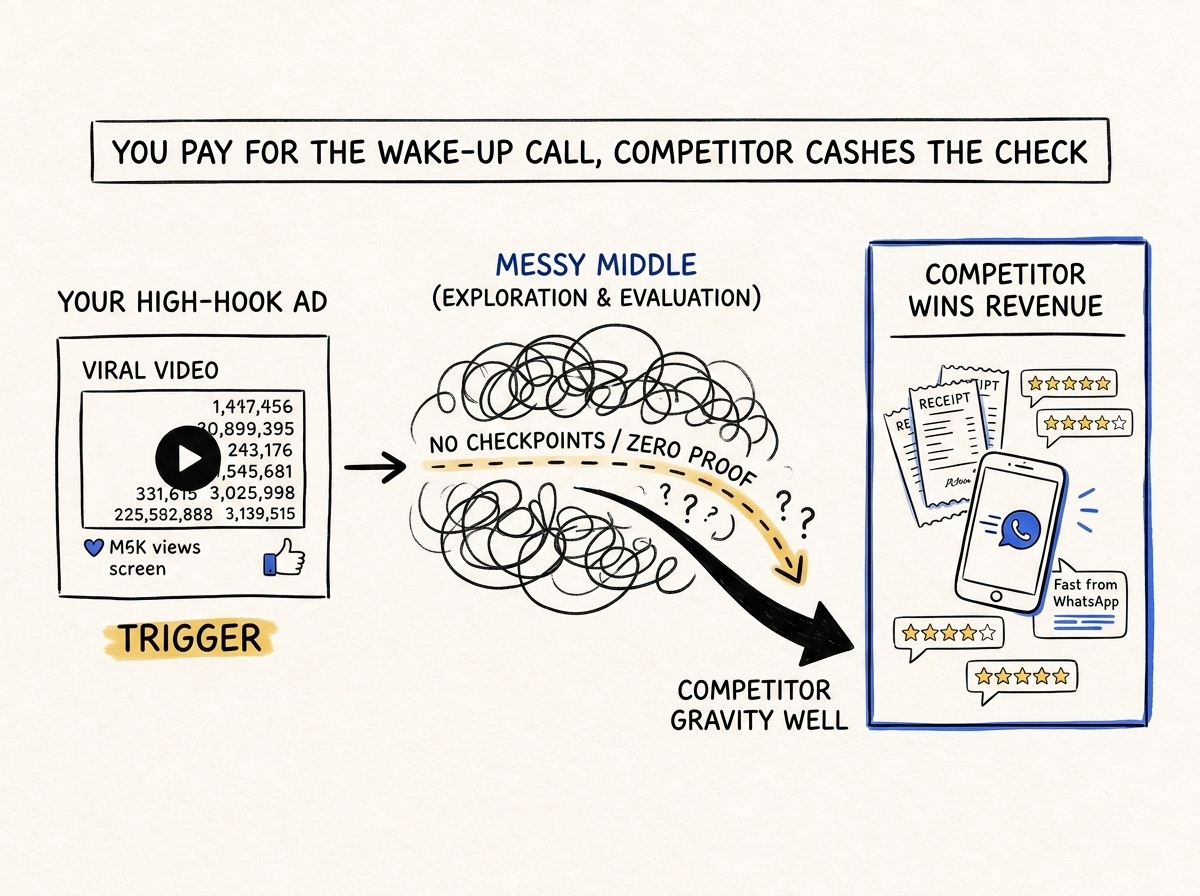
You spent the media budget to trigger category interest, while your competitor collected the revenue. That is the competitor subsidy trap. High-hook creative without commercial checkpoints is merely free awareness for your industry.
Are you paying to subsidize your competitors?
If your ad spend increases while qualified pipeline stays flat, your messy middle has leaks between demand, evaluation assets, and sales follow-up. In the 90-minute Constraint Audit, we isolate the exact bottleneck holding your revenue back before you spend another rupiah.
What Google actually wrote
Google’s 2020 study, Decoding Decisions: Making Sense of the Messy Middle by Alistair Rennie and Jonny Protheroe, never advised brands to surrender to chaos.
The researchers observed that between a trigger and a purchase decision, consumers loop through two distinct mental modes:
- Exploration: An expansive mode where consumers discover and evaluate multiple options, features, and alternative brands.
- Evaluation: A reductive mode where consumers narrow their choices by eliminating friction, risk, and unverified claims.
During this continuous loop, six behavioural biases govern consumer choices: category heuristics, power of now, social proof, scarcity bias, authority bias, and power of free. Google discovered that even an unknown challenger brand entering the messy middle with strong presence and credible proof could capture between 28% and 40% of consumer preference away from established market leaders.
Crucially, Google’s mandate for marketers was explicit: ensure brand presence so you are top-of-mind during exploration, apply behavioural principles responsibly, and close the gap between trigger and purchase to reduce the prospect’s exposure to competing brands.
Google described a challenge of consumer navigation. Too many marketers read it as permission to stop building navigational tools altogether.
Psychology is a loop. Business process is a state machine.
The flaw in the "funnels are dead" argument is the failure to separate human thought from commercial mechanics.
Human psychology is messy, emotional, and unpredictable. A buyer might see an ad in July, read a customer review in August, lose interest, see another ad in October, and finally initiate a purchase in November. That is non-linear wandering.
However, my principle is simple: the funnel is linear because the funnel is a sequence of business process checkpoints. In computing terms, a commercial funnel is a finite state machine. A customer cannot skip the physical laws of transaction progression:
- A buyer cannot reach
Purchasewithout first initiating checkout. - A buyer cannot reach
InitiateCheckoutwithout first adding an item to cart or clicking a direct offer. - A buyer cannot reach
AddToCartwithout first viewing the product content and price. - In high-ticket consulting, clinic services, or enterprise sales, no client signs without progressing through
LeadRegistrationtoQualificationtoConsultation.
Each step in this chain is a sequential, deterministic gate. The funnel was never meant to be a psychological map of human wandering. It is a commercial architecture designed to qualify, track, and process demand.
The customer has the freedom to wander across the internet. The business cannot afford a wandering data pipeline.
AIDA is for copywriting. Funnels are for telemetry.
Much of the industry confusion comes from treating AIDA (Attention, Interest, Desire, Action) as synonymous with the business funnel.
AIDA, developed by E. St. Elmo Lewis in 1898, is a communication framework. It governs how a message persuades human attention. AIDA can be executed completely within a single 45-second video script, a single landing page hero banner, or a four-sentence email. It is a formula for message delivery.
The funnel, by contrast, is an operational checkpoint system. It dictates business states: who has raised their hand, who has qualified, what conversion value was created, and where the drop-off occurred in the cash flow pipeline.
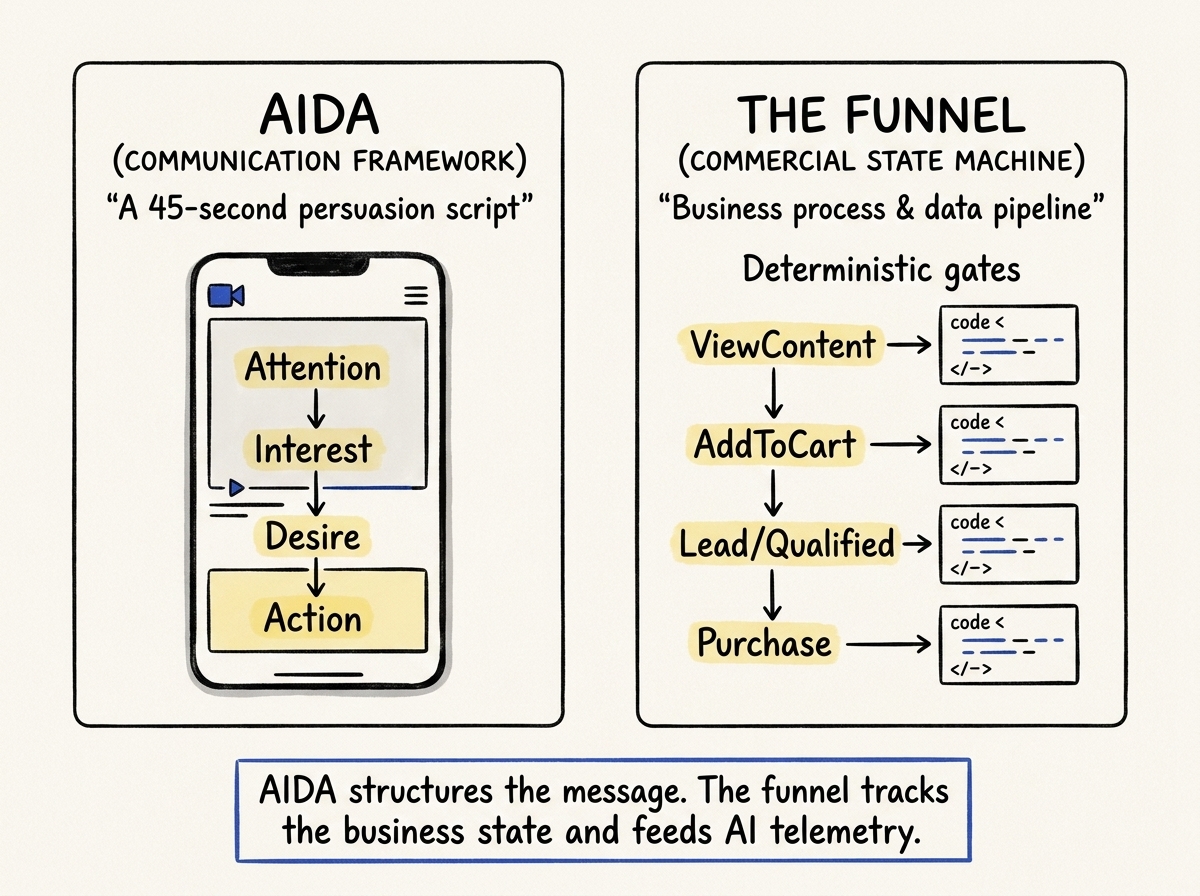
When marketers declare that funnels are obsolete because buyers do not think in AIDA stages, they are confusing a copywriting technique with the telemetry system of the enterprise.
Why AI makes linear checkpoints more critical
In the era of modern machine learning, represented by Meta’s Andromeda retrieval engine and Google’s Smart Bidding models, linear funnel checkpoints have become an absolute operational requirement.
AI advertising algorithms do not optimize on qualitative sentiment or brand vibes. They optimize on discrete, high-fidelity conversion signals.
When you rely exclusively on viral hooks without disciplined funnel checkpoints, the only signals you feed to the platform are shallow: three-second video views, profile visits, and cheap link clicks. The algorithm interprets those noisy signals literally. It spends your media budget locating users who watch videos and click links, rather than users who possess commercial intent and purchasing capacity.
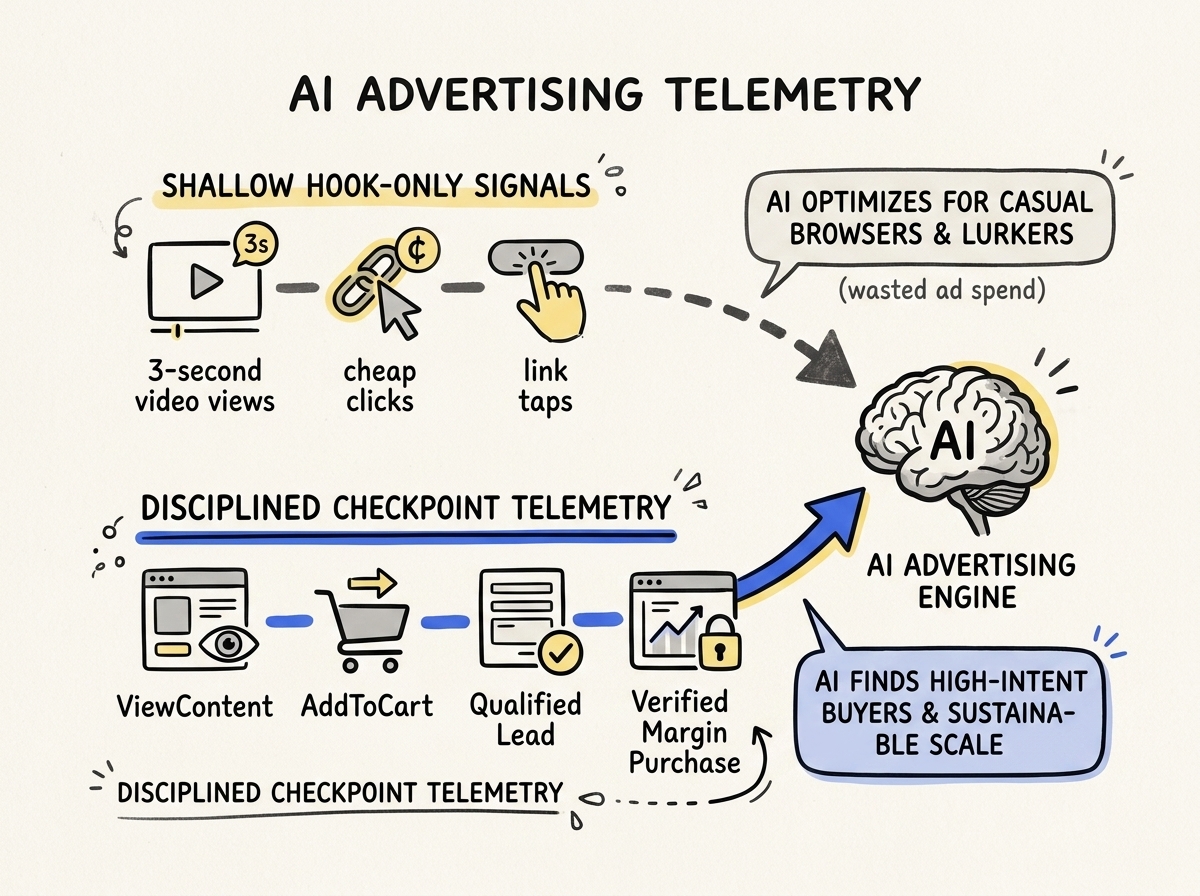
In my experience, sustainable scaling requires feeding the algorithm a clean progression of verified milestones:
ViewContent:Verifying that the prospect landed on an intentional offer page, not a bounced click.AddToCart / Intent:Verifying that the offer resonated enough to trigger financial intent.LeadRegistration / Qualified:Verifying that the prospect meets the business criteria before sales time is spent.Purchase:Recording real transaction value, net of refunds and fulfillment drag.
The cleaner and more linear your checkpoint telemetry, the faster the AI engine learns which audience profiles in the messy middle actually produce margin. Abandoning funnel discipline in an automated media environment is the fastest way to blind your own ad delivery engines.
The operator blueprint: four gravity checkpoints
Rather than attempting to force customers into an artificial straight line, an operator builds gravity checkpoints: assets and data gates placed strategically at every point where the messy middle meets the business process.
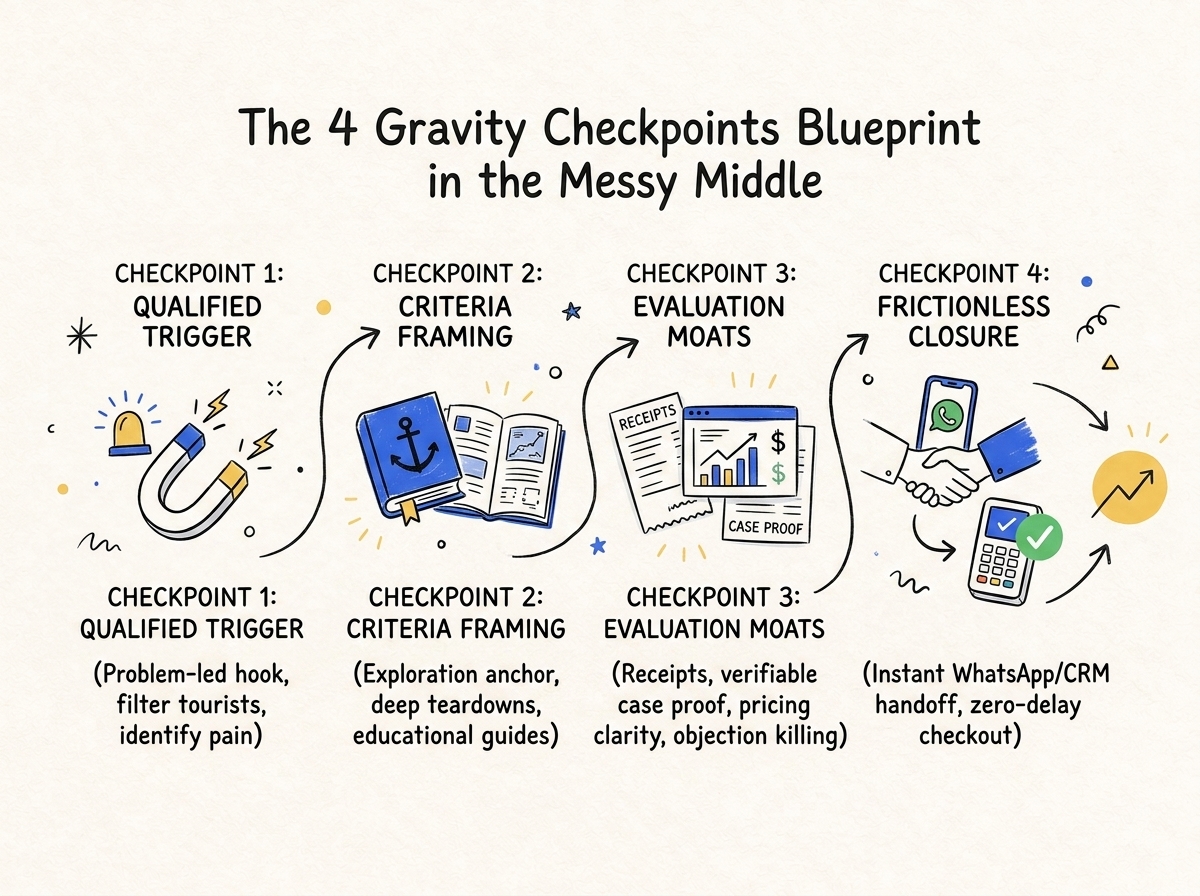
1. The qualified trigger
A hook must not merely generate view time. It must identify a specific problem, persona, or outcome. If an ad hook appeals to everyone, it filters no one. A qualified trigger attracts the right buyer and repels the tourist before spend is wasted.
2. Exploration anchors
When prospects enter the exploration loop, what do they find under your brand’s name? An operator provides criteria-framing content: teardowns, deep-dive articles, and educational guides that teach the prospect how to evaluate solutions properly. When you define the criteria, your solution becomes the benchmark.
3. Evaluation moats
Evaluation is where deals are won or lost. This checkpoint requires undeniable proof: verifiable receipts, before-and-after operational data, clear pricing structures, and candid handling of objections. Testimonials that say "great service" do not survive the messy middle. Detailed case breakdowns that show the exact constraint and the measurable outcome do.
4. Frictionless handoff and closure
Once the evaluation loop reaches decision momentum, friction must approach zero. For ecommerce, this means rapid checkout and immediate confirmation. For high-ticket services and clinics, it means instant WhatsApp routing, structured triage questionnaires, and fast follow-up from trained operators. Every hour of delay re-opens the exploration loop and invites a competitor back into the decision.
What really matters
The customer journey is unpredictable because humans are unpredictable. That is the reality of consumer psychology. But converting that human interest into durable enterprise value requires unwavering mechanical discipline.
Funnels did not die. What died was the naive expectation that customers would march obediently down a slide without asking hard questions.
The operators who win in 2026 are not those who surrender to the chaos of the messy middle. They are the operators who meet that chaos with clear checkpoints, clean telemetry, and a system that turns scattered attention into compounding revenue.

Aditya Indra Bayu
·Fractional CMO · InfinitiLabsAditya builds and operates commercial growth engines from the inside. He connects positioning, funnels, paid media, and sales telemetry until the business finds durable revenue.